Saturday, June 21, 2008

SONGCATCHER: A VISUAL INTERPRETATION OF SOUND at Lark and Key, Charlotte, NC


SONGCATCHER: A VISUAL INTERPRETATION OF SOUND

JULY 4th - AUGUST 31st (opening reception Friday July 11th, 6-9pm)

Thirty (plus) artists from around the country will be offering art, pottery, jewelry - or whatever medium strikes a chord - celebrating the diversity of music and its creative influence on their work. The show also aims to expose viewers to a world of music they may not be aware of. Various bands and djs will be playing during the opening and at the gallery crawls while the exhibition is up.

In an effort to give back to the community Lark & Key will also donate a portion of sales to the Belmont Community Center YWCA Afterschool Program. We will be working with the program director to provide funds for art and music related education for the children in order to encourage their creative spirit.

Participating Artists: Their styles and mediums are as diverse as their musical influences!

Adorn, Katherine Blackwell, Flora Bowley, Michelle Caplan, Sandra Dawson, Erica Diamond, Diana Fayt, Matt Flint, Charlotte Foust, Renee Gardner, Lisa Gastelum, Tim Gates, Jessica Gonacha, Duy Huynh, I’m Smitten, Carl Linstrum, Laura McCarthy, Jen McCleary, Nicole McConville, Myron Macklin, Cara Ober, Angie Renfro, Kate Phillips, Jessica Pisano, Ron Philbeck, Osiris Rain, TJ Reddy, Amy Sanders, Christy Smith, Melissa Tyson, Julie Wiggins

www.larkandkey.com

Gallery Imperato Summer Group Show July 11


Monday, April 28, 2008

Washington Post Express April 9

"Cara Ober Is Who She Pretends to Be" by Fiona Zublin. April 9, 2008.

Photobucket

CARA OBER's art show at the Randall Scott Gallery, "I am who I pretend to be," showcases paintings that almost seem like collages, with small, detailed drawings and poems superimposed on great swaths and splotches of color. Ober's work is deceptively simple and ultimately transcendent -- are the show closes this weekend, so go while you can.

» Randall Scott Gallery, 1326 14th St. NW; 11 a.m.-6 p.m., free; (202) 332-0806. (Dupont Circle)
Photo Courtesy Cara Ober

Sunday, April 6, 2008

Interview with the DCist March 31

Photobucket

March 31: DCist Interview: Cara Ober at http://dcist.com/2008/03/31/dcist_interview_23.php

Cara Ober is a painter, writer and teacher living in Baltimore and showing her work around the region. She teaches at the Maryland Institute College of Art, Towson, Johns Hopkins, and Loyola College. A lifetime area resident, Cara, 33, also writes art reviews for Art US Magazine, Art Papers, and Gutter Magazine. Her latest show, I Am Who I Pretend to Be, runs at Randall Scott Gallery through April 12.

What are some of the ideas and themes that your work engages with?

I am a storyteller, but my paintings have more in common with poetry than traditional narratives or prose. The stories I tell are mostly autobiographical and personal – my “material” is what I know, what I experience, and what I learn on a daily basis. Painting is a mode of thinking for me. It is a way for me to examine the fragments of memories and moments and to combine them in a way that is more interesting and, possibly, more real, than the way they were originally experienced.

The theme of memory in art seems really played out right now – a cliché – and, often times, I think an artist’s memories are so tender and so poignant that they interfere with the editing required for solid visual work. I think a lot of art about this subject – memory, consciousness, the unconscious – is half-assed.

However, I’m at a point where I know what I am interested in and there’s no getting around it. I can’t invent a concept and manufacture excitement about it. In graduate school, I attempted to be more “conceptual” in my studio practice and it always felt artificial and flat. I am interested in exploring the mystery of the personal self; the interior life lived in the brain, and, specifically, mine.

Photobucket
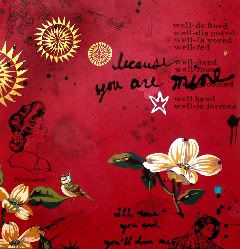
Well Meaning, Cara Ober
38x40"
Painting on canvas

Who are some of your artistic inspirations?

I think Louise Bourgeois is about as great as they get. She makes powerful works, which are simultaneously personal and universal, still and she’s in her nineties... About two years ago, the Walters Art Museum in Baltimore showcased Bourgeois’s works, in which over half were made in the last decade, but integrated it throughout the museum. So there would be a six hundred year old suit of armor next to a Bourgeois felt figure, an ancient Sumerian necklace next to a Bourgeois necklace… not only was it interesting to have to hunt for the contemporary work among the antiquities, but her work, so steeped in these dark and mysterious taboos, made me see this universal relationship between time periods, styles, and people. I’m not really interested in historical works of art – I prefer contemporary work – but Louise Bourgeois’s work in that context made me see the Walters’ collection in a new light.

How long does it take to make a typical piece?

The timing depends on whether the piece is cooperating or not. I’ve made terrific paintings in a week’s time... Working fast and furious is the best way for me to do two things: to make unselfconscious decisions and marks, and to inject a sense of urgency and passion into the work. The surprises that come from hasty painting are the spark that keeps them alive. I’ve also struggled for months and months on one painting, only to paint over it yet again. I typically paint over old paintings – I like to see the history of past decisions buried under the surface of the paint.

What materials do you work with?

I use acrylic and oil paint, both for different reasons. I use acrylic because I am impatient and like to work fast. I can rapidly build up a surface and then change my mind a lot – paint things in, take them out, paint over them, put them back in again – lots of back and forth. But I like to use oil for the top layer because the color is richer and more unpredictable, especially when thinned down into stains or pours.

Your new show at Randall Scott is entitled I Am Who I Pretend to Be. Is this a reference to the recent controversy with Christine Bailey?

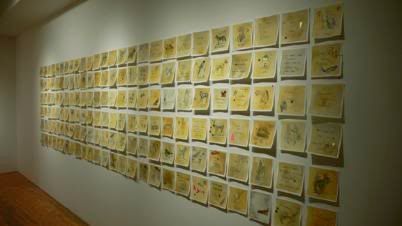
Yes and no. I started working on a series of small drawings, all about six by six inches, last November for the show at Randall Scott. I think I was feeling stumped and wanted to dissect the process of painting a bit, taking it apart piece by piece, make it more fun and less intimidating. So, I started out with all of these images from the dictionary, lots of dog breeds and musical instruments, just silly images, one on each piece of paper, and then I felt that the growing stack of drawings needed another half. I thought about what they all had in common and decided all are presented to the world as factual evidence. And we all know that facts are just part of the story. The other half is the opinions and intuitions lurking beneath the surface, most of which are not appropriate to share with others.
Photobucket

So I started working on another series of small drawings, to enhance the first series, just writing phrases you’re not supposed to say in public, and these became the "confessions," which complete the story. (The installation is called Confessions and Evidence, above, and is 160 drawings in all). One of the confessions I wrote at that time was “I am who I pretend to be.” I didn’t really think about it much… I mean, I write little phrases down all the time, especially when I am driving, and it made sense on a lot of levels. I think I was really thinking about that particular phrase in an inspirational way, like, you can be who you want to be – you can do it!

But later, after the "Bailey incident," as we call it here in Baltimore, I came across the statement and its meaning was completely different and not at all what I had intended. It just smacked me in the gut, this small drawing. Here was this person pretending to be me, in her work, and here I am, just trying to be myself, through the same exact process. It was bizarre. Like most of my decisions in the studio, that drawing was a happy accident and I didn’t even realize until long after I had made it. When I rediscovered that drawing, it felt like the theme of my work was staring me in the face and I have another artist to thank for it, I guess.

Do you have a favorite art spot or event in D.C. or Baltimore?

Yes. It is my studio! It is in my basement these days, after the condominium culture ate up my warehouse space. I try not to go out too much, although I do go to my share of art shows, especially in order to blog about stuff. I love going galleries that are professional without being snooty. I think the Randall Scott Gallery definitely fits this bill, and so does Gallery Imperato who reps me in Baltimore, as does Paperwork in Baltimore, which is a space I’ve opened up recently with my friend Dana Reifler.

How would you describe the art scene or community in D.C. or Baltimore?

As an artist who’s been showing both in D.C. and Baltimore for a couple of years, I have to say the two are completely different. I like making art in Baltimore, because I can afford to have a lot of studio space and freedom to experiment. Baltimore’s art community is supportive and warm, and is definitely thriving, but there isn’t much economic backing for it, other than grants. I sell a lot less work in Baltimore than in D.C., although the press in Baltimore is more encouraging, with lots of opportunities for reviews and write-ups.

In general, D.C. is a cooler, more intellectual city, and also more wealthy. I discovered blogging, after my first show in D.C. There were no art blogs in Baltimore a couple of years ago. There are many more professional galleries in D.C., which tend to exhibit commercial work and also a few more museums that collect contemporary work. This work isn’t always as dynamic or vital as the work I see produced in Baltimore, but it is definitely exhibited more professionally.

I think I am really lucky to be able to be a part of both the Baltimore and the Washington art community. I think I learn a lot, professionally, from both spots, although I get a lot more speeding tickets in Washington.

What do you see down the road artistically?

I like to be busy making things at all times. My goal would be to have projects aplenty, some solo and some collaborative, for the rest of my life. I would like to teach less and paint more. I would like to continue to curate exhibits with interesting people and in challenging places. I would like to get paid to write about art. I would like to travel to lots of new places to make, curate, and write about art. I would like to be awarded some grant money so I can do nothing but make paintings for a while and not leave the studio and really get to know myself. And eventually, I would like to be a really busy old lady, as ready for the next painting, and the next show as I am now.

To hear more from Ober, the Randall Scott Gallery will be holding an informal chat with her on April 5 from 4:30-6 p.m. Brandon Fortune, curator of painting at the National Gallery and Kriston Capps, critic for the Washington City Paper and blogger will conduct an informal interview with Ober about her work.

By Amy Cavanaugh in Arts and Events

Friday, February 22, 2008

NEW PAINTINGS AND A WALL BY CARA OBER; A WARNING TO VIEWERS -- Essay by Dr. Michael Salcman

Photobucket

“Painting as a mode of thinking” is the way Holland Cotter described the landscapes of Poussin in a recent New York Times review. He likened Poussin’s artistic practice to a certain kind of poetry in which “antique references, modern speculation and sensual delirium” check and fuel the import of each component. A viewer might do well to keep this conflicted discursiveness in mind when looking at the paintings of Cara Ober. Her art can look deceptively inviting, almost reassuring in its Hallmark Hall greeting card sort of way, as if the meaning of her jumbled references to old-time dictionary illustrations, sentimental silhouettes, wallpaper patterns and middle class sense and sensibility were simply meant to give us pleasure, the concatenation of images and words an apotheosis of middlebrow taste somewhat like the effusions of Jeff Koons, another notable graduate of the Maryland Institute College of Art. But you would be mistaken to think so. Perhaps like Ober you too are a product of suburban America, perhaps like her you too feel conflicted about the comfortable sources of your pleasures, how often they are rooted in a familiar environment, the taste of chocolate cake, a submissive pet, a doting mother, a non-threatening mate. Perhaps her older work made it easy for you to feel some such generational kinship but the new paintings are darker in color, more subtly threatening in their selection of quotes and definitions, more aggressive in their critique. They will remind you that you are not like Cara Ober.

Photobucket

The new paintings require a type of “slow looking”, the eye moving from image to image, the brain attempting to puzzle out Ober’s meanings. The layering of images in modern art has a storied history and a distinguished if controversial line of practitioners including Francis Picabia, Robert Rauschenberg (a hero of Ober’s), Sigmar Polke and David Salle, an artist guaranteed to raise the hackles of anyone with feminist sensibilities. In the layered work of these artists, disjunctive visual signs are used as grammatical equivalents of words in a sentence; Ober’s more lyrical paintings are part of this tradition, visual equivalents to the L=A=N=G=U=A=G=E school of poetry in which sound takes precedence over sense, and placement is privileged before meaning. In Picabia the images are literally placed one on top of the other and the layering often achieved through the foregrounding of pentimenti, evidence of previous attempts at achieving visual coherence. This is not Ober’s way, her method closer to that of Rauschenberg and Salle in which the images are dispersed across an abstract expressionist field or ground in the manner of a visual puzzle. Whether these puzzles are actually capable of solution is another matter. Rauschenberg even called one of his most famous combine paintings “Rebus”, the term used for a kind of visual puzzle endemic to game shows but neither his work nor Salle’s is susceptible to a single interpretation, and neither is the work of Ober. You have been warned. On the other hand, there are philosophical and sociological points being made, some of which clearly relate to how art is produced and received; this strategy aligns her with Polke, a contemporary master devoted to the alchemical nature of process, the deconstruction of printing and typography, the flexible meaning of emotionally fraught images both old and new.

Photobucket

With their lipstick colors and feminine cursive, the pre-Pop prints and drawings of Andy Warhol may be Ober’s closest visual ancestor of all; see especially the hand-colored lithographs in A la Recherche du Shoe Perdu (1955) and his series of watercolor cats and butterflies. Like Warhol, Ober calibrates the visual balance between word and image; unlike his cool effusions, she adjusts the emotional heat of her work up or down by introducing stenciled dictionary definitions in the manner of Kosuth and fragments of provocative poetry. And Ober gives her words and images equal visual weight. For this reason alone her work is subliminally hot, unlike the dead pan dictionary photostats of Joseph Kosuth or the gunpowder drawings of Ed Ruscha. In their work words serve as image and conceptual trigger, taking over the entire surface and meaning of the painting or its photographic equivalent. Whether taking her words from her own journal or from poet-friends, Cara Ober is deeply invested in the emotional power of language. Many visual artists are instinctively drawn to poets and their work by the image-making properties common to both art forms: on the one hand, the representation of objects through mark making, on the other, the evocation of images by metaphoric means. The use of words as components in visual compositions begins with Cubism and its invention of collage as an artistic strategy, a means by which the art work became an object in the real world through the reciprocal insertion of fragments from that world, a headline from a newspaper, a musical staff, a torn sheet of faux bois wallpaper; at this critical juncture, Picasso and Braque were surrounded by many friends and associates who were writers and poets: Apollinaire, Max Jakob, Cocteau, and Gertrude Stein. Years later a literary movement actually spawned an entire visual style. Paintings and poems have been twisting around one another ever since, like two strands of DNA. Ober’s paintings are a recent elaboration of this tendency.

Photobucket

As already mentioned, Ober often employs a delicate “wet” looking scrawl that resembles the blotted line in the early autographic (pre-POP) drawings of Andy Warhol, an artist similarly conflicted about his upbringing; both artists use this technique to draw domestic cats and innocent butterflies, things we are sometimes ashamed to love openly because they are often despised by intellectuals or by the more rational and self-impressed half of our own consciousness. In a painting like “born for better things”, you can still see his influence, especially in the pistols and revolvers so exquisitely hand-drawn that they look like Warholian screenprints; similarly her Pop-inflected 1950s floral patterns look like collage but are not. In this painting, the darker import of the images is reinforced by the aggressively frontal portrait of a dog’s head as well as the scripted message “I will wait but not forever” and the stenciled dictionary definition of “birthright”. The recurring images of Joker playing cards are an almost too-pointed reminder of the game being played on us, the superficially cloying sentimentality and kitsch aesthetic giving way to serious business, the power of the artist to fool the eye and control our emotional weather. How Ober feels about her self-identification with the Joker, the classic camp villain of the Batman comics, is uncertain; we cannot know what she knows, even about herself. Another warning of serious intent is Ober’s employment of opaque figures painted in black that resemble nothing so much as Kara Walker’s sociologically charged silhouettes, themselves as much about femininity as they are about race. You can see this in the lower right-hand corner of “lowdown”, one of the best paintings, fierce despite its use of the older palette as a ground. In the revealingly titled “i regret saying these things too softly”, the dancing couple in the lower right serves a similar purpose and is counterbalanced by the ominous cascade of black paint in the upper left. The instability of truth, whether visual or sociological, is heralded by the choice of her other images, the Joker from an old playing card, the image of a mockingbird, the dictionary definition of a duck decoy. Ober’s pictorial universe is simultaneously campy and obnoxious, sentimental and strident, decorative and awkward, mute and sounding off.

Photobucket

I have already mentioned the scrawled line that Ober uses for quotes from Bob Dylan, from her own journal entries, from pop songs and greeting card verse. Not only are these mostly sentimental messages forced to abut her images but they also must deal with stenciled texts, seemingly banal definitions that she appropriates from her collection of old dictionaries. In “lowdown” the text is taken from Dylan’s “Idiot Wind”, “passing stranger/ someone’s got it in for me/ I can’t help it if I’m lucky”, the quote menacingly divided, the boxer’s head facing the first part. Above the scrawl, Ober has juxtaposed the definition of “lowdown”, a slang term for truth. Over the past few years, her choice of text has darkened along with the color of her figurative and literal ground, almost always implying a feminine critique of masculine appurtenances, male dogs, weapons and tools: since these are the words most frequently illustrated in the old dictionaries, Ober gives us the accompanying drawings, fashioned to look like early lithographs and places them next to the text. In the beautiful “winter into spring”, the hopefulness of the scrawl and the sentimental definition and image of a rickshaw are cancelled by the blot of thrown paint. Across the scumbled abstract expressionist ground of her work, the skin and stain of her acrylic, Ober repeatedly confronts comfort and discomfort, acceptance and criticism, feminine and masculine. In “well-meaning”, the romantic scrawl (“because you are mine”) is negated by the old-fashioned woman with a pompadour hair-do and the male astronaut facing away from her.

Photobucket

And then there is the wall. Ober has assembled about 150 sheets of six by six-inch paper, each covered with watercolor, gouache, gold leaf and the occasional element of true collage. If her individual canvases seem at first glance like lyrical songs, decorative assemblages of non-threatening images, are her wall-sized concatenations of multiple sheets more akin to symphonies? In taking up this strategy Ober has relatively few precedents, Jennifer Bartlett, Felix Gonzalez-Torres, Jim Hodges, Joseph Grigely, and Zak Smith come to mind. Bartlett is the most apposite because she is female and her images are similarly non-threatening and superficially neutral; like Gonzalez-Torres, Bartlett’s paint drop plates and the orchestration of images in “Rhapsody” come out of a post-Minimalist aesthetic. When Gonzalez-Torres traces his lymphocyte counts on graphs he uses the emotionally neutral or cool armature of the grid; without some background information or knowledge of a title we can only guess at the emotionally loaded nature of his project. Hodges fabricates walls of painted flowers that are more object-oriented than the work of Ober. Grigely’s casual notes, meal receipts and phone messages, his “inscribed conversations”, are mementos of his daily exchanges as a non-hearing person negotiating the hearing world. Zak Smith’s most famous wall is even more explicitly language-based even though no words appear; it consists of more than 700 drawings and photo-paintings inspired by every page in his copy of Gravity’s Rainbow (2006). Like Hodges and Smith, Ober’s sheets are physically delicate, seemingly humble and frankly autographic. Like her individual paintings, the “mural” is more than a puzzle meant to be solved, it’s a metaphor for the random connections of daily thought. Because half the piece consists of dictionary images she calls “evidence”, and the other half is primarily text Ober terms “confessions”, we once again sense that familiar unease that Ober injects beneath the surface of her outwardly well-behaved pictures. Unlike a painting, in which the confrontation of text and image must be balanced for color and scale, everything on this wall is given equal weight. Read left to right from a distance, the wall becomes a collection of thoughts and sensations more random than any a painting might achieve; up close we are subsumed in the welter of its jumping off points. If not for the division between image and text the eye wouldn’t know where to turn first. It’s difficult to predict what the recent emergence of wall-sized work presages for her artistic program but it surely is not an attempt to make things easier for the viewer. I strongly suspect she is done with the regret of saying things too softly. Like I said, you’ve been warned.

Photobucket

Cara Ober: 'i am who i pretend to be' opens at RSG March 8

Photobucket

March 8 - April 11
Reception Saturday, March 8 at 7 p.m.

The most unlikely pairing of visual elements, culled from home décor, fashion, old reference manuals, and action painting forms the visual vocabulary of Baltimore based painter Cara Ober. These works act as an entry point into the artist's unconscious; the connections between disparate images create a visual poetry, full of meanderings and musings, paired with suggestion and associations. Ober's method for constructing meaning is of her generation; she catalogues, documents, and pieces together fragments into internal maps, which document a moving through time.

"You can't understand beauty without loss. And I can't take either of these ideas seriously without an undertone of humor or irony. In every solemn occasion, there is always a subtext of anxiety or mischief, a story that is hidden. In my paintings, the most serious and silly elements combine and interact on the canvas, unfolding a narrative that is striking in contradiction, absurd in paradoxical blather, and authentic in poignant longing. I don't desire to depict these ideas, rather to reenact them on the canvas, through an odd balance of extremes." writes Ober.

Ober's canvases, rich in layers of ideas worked, rethought, reworked and painted with an exuberant and excited hand, is akin to a late night conversation shared over numerous cups of coffee, or glasses of wine. Focused in the moment, with thoughts flying in every direction, these works act like an improvisational jazz riff that never looses track of the melody, while never drawing recognition to it in sequence, either.

These explorations, presented in text, color and visual layers create a multidimensional narrative. As in life, there is no singular meaning, no clear definition. Ober's narratives, by use of juxtaposition and unlikely relationships, can be read in any number of ways, encouraging a viewer to roll in their own associations and to enrich the experience.

"My conception of validity is entirely subjective, based on my suburban upbringing, my sense of humor, and my own tunnel-vision rebellion. There is a sense of play and meditation in my work, found in the stream-of-consciousness chatting I document, and also frustration, loss, and nostalgia. The search for meaning and reflection in the scrutiny of the evidential details is what fuels me, although the paintings typically yield unexpected outcomes, and answers to questions I haven't asked yet."

Cara Ober earned her MFA from the Maryland Institute College of Art in 2005. Based in Baltimore, MD, Ober teaches at MICA, Johns Hopkins University and Towson University. She also writes for several local publications on the arts and curates an exhibition space in Baltimore that showcases works on paper. In the past year, her work has been shown in a number of local and national exhibits, including second prize in The 2007 Bethesda Painting Awards, and a solo show at Flashpoint In Washington D.C.